
Your Biggest AI Advantage Is Your Boring Data
Your Biggest AI Advantage Is Your Boring Data
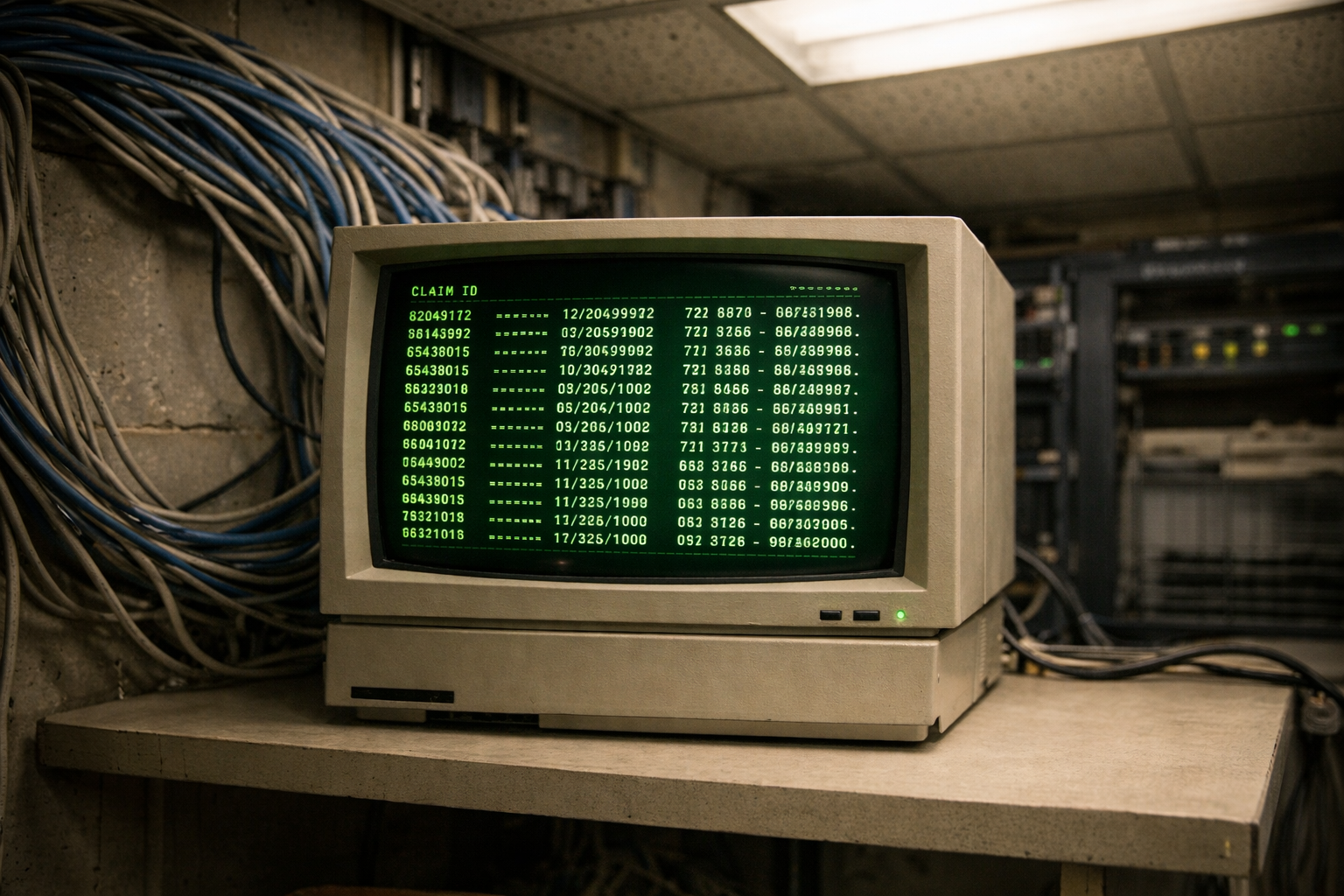
A regional health insurer has 35 years of claims adjudication records sitting in an AS/400 system nobody wants to touch. Every claim has a disposition, a processing path, an adjuster's notes, and an outcome. Forty million rows. No one has built a dashboard on it in five years. The CTO calls it technical debt.
That dataset is worth more to an AI agent than anything OpenAI has ever trained on.
What foundation models have never seen
GPT-4, Claude, Gemini: trained on the public internet. Books, forums, Wikipedia, code repositories, news articles. Enormous breadth. Zero depth on how your specific business operates.
A foundation model knows what insurance is. It can define subrogation, explain the difference between HMO and PPO plans, draft a policy summary. It has never seen your denial patterns, your adjuster routing logic, your seasonal claim volume spikes, or the 23 edge cases your senior claims team handles from memory because they've processed variations of the same scenario for a decade.
That gap is permanent. No future model release closes it. OpenAI cannot train on your transaction history because they don't have it. Anthropic cannot fine-tune on your maintenance logs because those logs live in a proprietary system behind your firewall. The foundation model gets smarter at general reasoning every quarter. It never gets smarter about your business unless you feed it your data.
The readiness trap
92% of companies say their data isn't AI-ready. That statistic gets cited in every vendor pitch and every board deck as evidence that enterprises need to clean up before they can start.
The framing is backwards. "AI-ready" as most organizations define it means structured, deduplicated, in a modern data warehouse, accessible through clean APIs. That's the standard for a BI dashboard. It has almost nothing to do with what makes data valuable for AI.
A foundation model fine-tuned on messy, domain-specific data outperforms a general model operating on pristine but generic data. Researchers have demonstrated this consistently: a small language model fine-tuned on specialized training data significantly outperforms GPT-4 at zero-shot classification in the same domain. The effect is most pronounced in non-standard, specialized tasks, exactly the kind of work enterprises care about.
The data doesn't need to be clean in the way a data warehouse team defines clean. It needs to be yours.
Three kinds of boring data that matter
The data with the highest AI value tends to be the data that looks the least impressive in a slide deck.
Transaction histories. Every claim processed, every order fulfilled, every loan approved or denied. These aren't records; they're decision patterns. An agent trained on your claims history learns which denials get appealed, which appeals succeed, which combinations of diagnosis codes and treatment plans trigger manual review. That knowledge took your senior adjusters years to accumulate. The agent absorbs it in hours, then applies it at a scale no human team can match.
Maintenance and operations logs. A manufacturer with ten years of equipment maintenance records has a dataset that predicts failures before they happen. One telecom used decades of legacy fault logs to train predictive models for network failures, combining archived data with current sensor readings. The result was a predictive maintenance system that reduced outages. Those fault logs had been sitting in a decommissioned system, considered low-priority data.
Internal communications and knowledge. The email threads where a regional manager explains why a particular customer segment behaves differently in Q4. The wiki article that documents the workaround for a billing system edge case. The support tickets that reveal the actual, as opposed to documented, process for handling escalations. This is the organizational knowledge that walks out the door when people leave. It's the context that makes an AI agent useful rather than generic.
The moat nobody recognizes
McKinsey's 2025 survey found that 79% of organizations report competitors making similar AI investments. Everyone has access to the same foundation models. Everyone can hire the same integration partners. Everyone can buy the same orchestration platform.
The differentiator is what you train those models on. A startup with clean data and a modern stack but no domain depth loses to the incumbent sitting on twenty years of messy transaction records, because the incumbent's data encodes decisions that no public dataset contains. How your customers actually behave. Which processes actually fail. What your senior people actually do when the standard procedure doesn't apply.
This is the part most data readiness conversations miss. They treat legacy data as a liability to be migrated and cleaned. The organizations that figure out how to make legacy data accessible to AI models, without a multi-year warehouse modernization project, will have a compounding advantage that's difficult to replicate.
What happens when you decommission
Organizations decommission legacy systems every year. Mainframes retired, ERPs migrated, homegrown platforms sunsetted. The data usually gets archived in a format optimized for compliance: searchable enough to satisfy an auditor, not accessible enough to train a model.
Predictive models thrive on deep historical context. They need that data to spot long-term cycles. Decommissioning a legacy system without an active data strategy means permanently deleting AI's long-term memory of your business.
The claims processor who retired last year took thirty years of pattern recognition with them. The AS/400 scheduled for decommissioning next quarter holds the same institutional knowledge in structured form. Losing the person was inevitable. Losing the data is a choice.
The practical path
This doesn't require a clean-room data initiative or a two-year modernization project. Three moves make the difference.
Make legacy data queryable, not migratable. Virtualization layers, API wrappers, read-only access to archived databases. The goal is to let AI models reach the data where it lives, not to move everything into a lakehouse first. Batch synchronization works for most use cases; real-time access is only necessary for a minority of workloads.
Start with one agent and one dataset. Pick the workflow where your people have the most institutional knowledge and pair it with the historical data that encodes that knowledge. Claims adjudication, equipment maintenance, customer escalation routing. Build one agent that's better than the generic alternative because it knows your data. That's the business case.
Treat decommissioning as a data strategy event. Every legacy system retirement should trigger the question: what's in here that would make an AI model better at our business? Most organizations archive for compliance and stop there. Extracting data for intelligence is a separate action, and it's the one that compounds.
The asset you already have
Every week, another vendor pitches a platform that promises AI transformation. Every platform runs the same foundation models. The differentiation is in the data layer, and the data layer is the thing you've been accumulating for decades while waiting for a reason to use it.
The companies complaining loudest about data readiness are sitting on the most defensible assets in their organization. They just defined readiness wrong.
The model that knows your business beats the model that knows everything else. The data that makes it yours has been sitting in your systems the whole time.
Bill Sourour is the founder of Arcnovus, a technology advisory firm that helps enterprise leaders turn the data they already have into AI capabilities that compound. If you're sitting on decades of proprietary data and aren't sure where to start, let's talk.

Bill Sourour
Founder, Arcnovus
25 years in enterprise technology. Writes about AI strategy for CTOs.


'/%3e%3c/g%3e%3cuse%20xlink:href='%23h'%20transform='rotate(180)'/%3e%3c/svg%3e)